
What is SLS?
SLS stands for selective laser sintering. It is one of the powder bed fusion processes in additive manufacturing: in a bed of plastic powder, a laser fuses exactly those areas that belong to the part. Layer by layer, this produces a dense, load-bearing part.
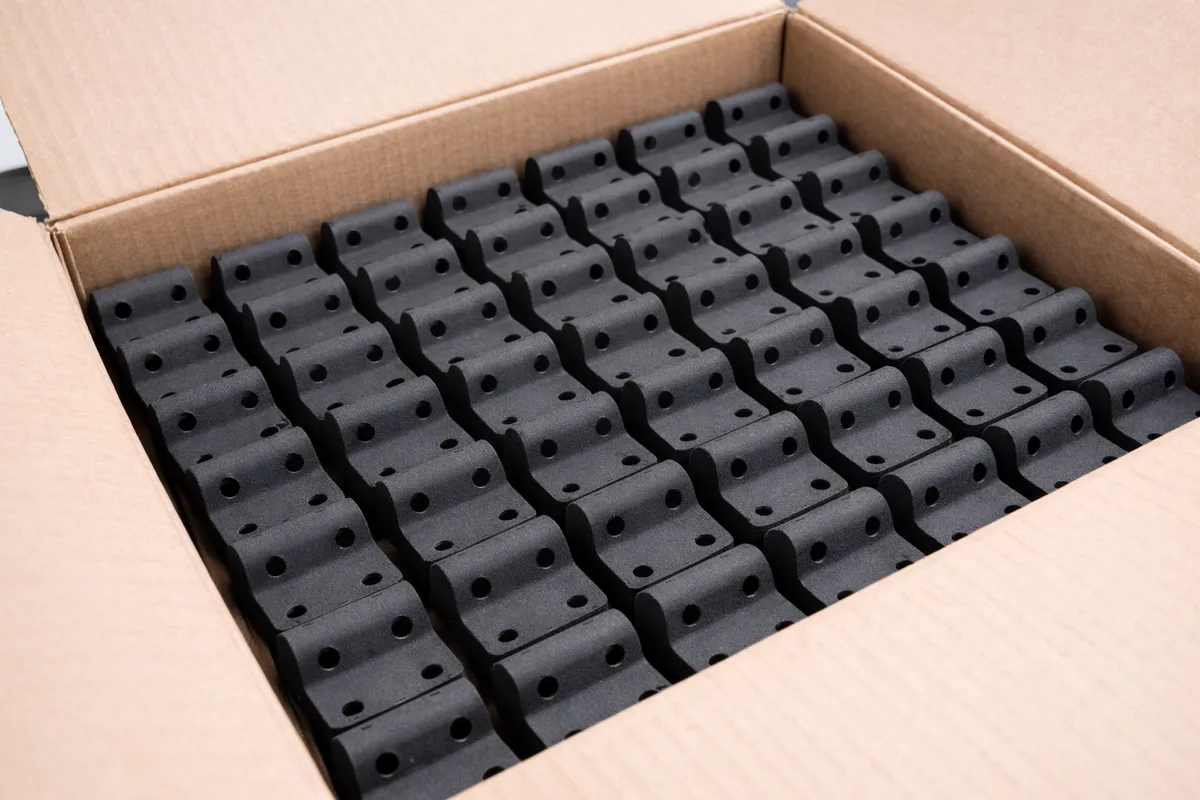
The most important material in SLS is polyamide 12, PA12 for short. It combines good toughness with dimensional stability and resistance to oils, fuels and most cleaning agents. SLS parts in PA12 are therefore not display models but functional parts: housings, holders, clips, covers, ventilation and cable guides, spare parts.
How selective laser sintering works
A build job runs in six steps, from the data set to the finished part:
Prepare the build volume
The parts are arranged digitally in the build volume. Because no part has to stand on the platform, many parts can be nested above and inside one another.
Apply and preheat the powder
A thin layer of PA12 powder is applied and heated to just below its melting point.
Expose
The laser traces the cross-section of every part in this layer and fuses the powder at exactly these points.
Build layer by layer
The platform lowers by one layer, new powder is applied and the laser exposes the next layer. This repeats up to the top layer.
Cool down
The powder cake cools down in a controlled way. This is important for the dimensional accuracy of the parts.
Unpack and post-process
The parts are removed from the powder, depowdered and blasted. Unsintered powder is reprocessed and reused.
Advantages for series parts
No tooling
There is no mould and no tooling cost. The first part costs as much as the hundredth, and a design change needs only a new data set.
Geometric freedom
Undercuts, internal channels, cavities and moving assemblies in one piece are possible, because the powder supports the part during the build.
Economical in series production
The entire build volume can be filled with parts. Small and medium-sized parts are thus produced by the dozen or by the hundred in a single order.
Functional properties
PA12 from SLS is tough, impact-resistant and resistant to media. The parts are suitable for use in the finished product, not just for prototypes.
Short lead time
Without toolmaking, days rather than weeks lie between the data and the finished part.
Limits and what to watch out for
Surface
SLS parts have a fine, slightly grainy, matt surface. Blasting makes it even, polishing smoother and more sealed. SLS does not achieve mirror-smooth visible surfaces as in injection moulding.
Tolerances
Typical industry values for SLS are around ±0.3 % of the dimension, at least approximately ±0.3 mm. We clarify tighter fits on the specific part.
Anisotropy
In the build direction (Z), elongation at break is lower than in the build plane: for PA12 around 6 % compared with 11 %. We orient highly loaded parts accordingly.
Water absorption
PA12 absorbs little water (0.66 % according to ASTM D570). For pressure-tight applications, the design must be checked on the part.
Part size
A part may be no larger than 160 × 160 × 297 mm. Larger parts can be split and joined.
SLS compared with injection moulding, FDM and MJF
Which process fits depends on quantity, geometry and requirements. The table shows typical differences.
| SLS (PA12) | Injection moulding | FDM | MJF (PA12) | |
|---|---|---|---|---|
| Tooling | none | mould required, high one-off costs | none | none |
| First parts | after days | after weeks | after days | after days |
| Support structures | none | – | usually required | none |
| Mechanical properties | isotropic in the plane, tough | very good, isotropic | strongly direction-dependent | similar to SLS |
| Surface | matt, finely grainy | smooth, any finish | visible layers | matt, finely grainy |
| Economical up to | medium series | large series | single parts, small series | medium series |
When does SLS pay off in series production?
Injection moulding has high one-off costs for the mould and very low unit costs thereafter. SLS has no one-off costs but constant unit costs. Where the two curves cross depends mainly on the size of the part and the complexity of the mould: for small and medium-sized parts, this point is often at a few hundred to a few thousand pieces per year.
SLS also pays off wherever the design is still changing, where parts are reordered in small quantities over years (spare parts), or where a geometry could not be produced by injection moulding at all, or only with slides.
PA12 material: properties
Properties of polyamide 12, sintered on the Formlabs Fuse 1+:
| Tensile strengthASTM D638 Type 1 | 50 MPa |
|---|---|
| Tensile modulusASTM D638 Type 1 | 1850 MPa |
| Elongation at break in X and YASTM D638 Type 1 | 11 % |
| Elongation at break in ZASTM D638 Type 1 | 6 % |
| Flexural strengthASTM D790-15 | 66 MPa |
| Flexural modulusASTM D790-15 | 1600 MPa |
| Impact strength, notchedASTM D256-10 | 32 J/m |
| Heat deflection temperature at 1.8 MPaASTM D648 | 87 °C |
|---|---|
| Heat deflection temperature at 0.45 MPaASTM D648 | 171 °C |
| Vicat softening temperatureASTM D1525 | 175 °C |
| Water absorptionASTM D570 | 0.66 % |
| FlammabilityUL 94 | HB |
Design rules for SLS
With these guide values, parts come out clean and dimensionally accurate. Below them, details lose definition, holes can close up and thin webs can break.
| Wall thickness | min. 0.6 mm vertical, 0.3 mm horizontal |
|---|---|
| Holes | Diameter min. 1.0 mm |
| Pins | Diameter min. 0.8 mm |
| Cavities | Powder escape holes min. 3.5 mm, two per cavity |
| Moving parts printed in one piece | Gap 0.3 mm up to 20 mm² area, 0.6 mm above |
| Fit between separate parts | Clearance 0.2 mm up to 20 mm² area, 0.4 mm above |
| Embossed text | min. 4.5 mm high, 0.3 mm raised |
| Engraved text | min. 3.0 mm high, 0.3 mm deep |
| Part size | up to 160 × 160 × 297 mm |
| Raised, horizontal surface | 0.15 mm high, 0.35 mm wide |
|---|---|
| Raised, vertical surface | 0.35 mm high, 0.4 mm wide |
| Recessed, horizontal surface | 0.1 mm deep, 0.3 mm wide |
| Recessed, vertical surface | 0.15 mm deep, 0.35 mm wide |
| Separate parts in the same build | min. 1.0 mm apart, 5.0 mm recommended |
Post-processing
Depowdering
Residual powder is removed from the part and its cavities.
Blasting
For an even, matt surface.
Dip dyeing
Dyed throughout in an immersion bath.
Polishing
For a smoother, sealed surface.
SLS series production at Volumetrix
Volumetrix manufactures PA12 series parts on its own machines in Switzerland and finishes every part in its own workshop. Same-day production is possible, with delivery from 24 hours.
The process: you send STEP data or a drawing, check a sample part on your own component and then order in series, with the same powder and the same parameters. On request with a framework agreement, fixed prices and call-off as needed.
Frequently asked questions about SLS 3D printing
What does SLS mean in 3D printing?
SLS stands for selective laser sintering. A laser fuses plastic powder layer by layer into a part. The surrounding powder supports the part, so no support structures are needed.
Which material is used in SLS?
Most commonly polyamide 12 (PA12). Volumetrix manufactures exclusively in PA12: tough, dimensionally stable and resistant to oils, fuels and most cleaning agents.
How accurate are SLS parts?
Typical industry values are around ±0.3 % of the dimension, at least approximately ±0.3 mm. We clarify tighter tolerances on the specific part.
How large can an SLS part be?
At Volumetrix up to 160 × 160 × 297 mm. Larger parts can be split and joined.
What wall thickness does an SLS part need?
At least 0.6 mm for vertical and 0.3 mm for horizontal walls. Holes should have a diameter of at least 1.0 mm, pins at least 0.8 mm.
How quickly can SLS parts be delivered?
At Volumetrix, same-day production is possible, with delivery from 24 hours.
Can SLS parts be dyed?
Yes. PA12 can be dyed throughout in an immersion bath. Blasting and polishing additionally improve the surface.
When is SLS cheaper than injection moulding?
As long as the tooling costs of injection moulding cannot be spread over enough parts. For small and medium-sized parts, the threshold is often at a few hundred to a few thousand pieces per year; SLS is also cheaper for designs that are still changing and for spare parts.
What is the difference between SLS and MJF?
Both are powder bed processes using PA12. In SLS a laser fuses the powder; in Multi Jet Fusion (MJF) an infrared lamp does so together with a printed fusing agent. The parts are similar in material and application.
Which files does Volumetrix need for an enquiry?
Ideally STEP data, alternatively STL, plus a drawing as PDF if tolerances or fits are important.